The Sox Passing Challenge
Kevin the Star StrikerThe Sox Passing Challenge is the pivotal training match in which Larry teaches the Wild Soccer Bunch that individual brilliance cannot replace cooperation. Sox becomes both opponent and instructor: his speed exposes the team’s inability to pass, while the eventual seventeen-pass sequence gives the players a shared identity, a battle cry, and the practical foundation for their later comeback against the Unbeatables.
Purpose and Setup
Larry designs the challenge specifically to confront Kevin’s selfish style of play. Kevin identifies himself as the star striker and master dribbler, admits that he is in love with the ball, and rejects the idea that Larry can change him. Larry answers that he does not need to change Kevin directly because Sox will do it for him. The exercise therefore turns a personal argument into a measurable football problem: Sox will occupy the center, and the players must complete ten passes before he can take the ball. Larry presents success as proof that they are the best soccer players in the world, while Tyler immediately objects that seven players should easily defeat one dog.
The challenge also extends Larry’s broader demand for trust. When Diego asks what the team’s fear means for its chances, Larry insists that fear is their strength and that victory over the Unbeatables depends on complete mutual trust. The passing exercise gives that abstract principle a physical form. Each player must move the ball away from personal control, read a teammate’s position, and act quickly enough to prevent Sox from exploiting hesitation.
First Attempts and Kevin’s Lesson
The first direct test confirms Larry’s diagnosis. Kevin tries to defeat Sox with individual technique, faking left, turning rapidly, and sending the ball with his left heel to the right. The move displays the kind of deception that makes Kevin proud of his own skill, but Sox refuses to be fooled. After shifting his head aside, the dog springs forward and takes the ball in his teeth. Kevin then concedes that the team needs work and asks what to do. Larry reduces the lesson to its essential terms: pass, quickly and precisely.
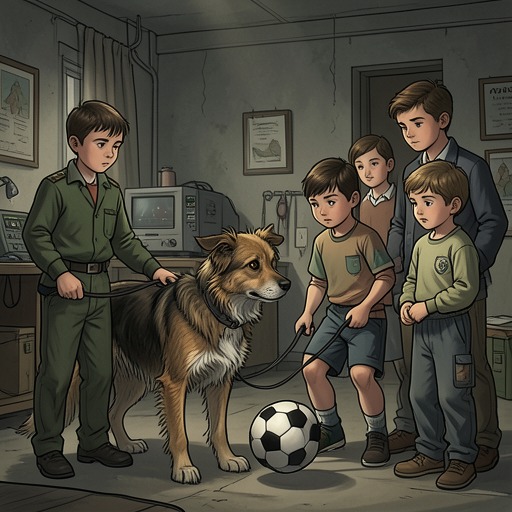
The group’s early progress remains poor. After two hours of training in the blazing midday sun, the Wild Soccer Bunch manages only three passes, while Sox remains energetic, barking, wagging his tail, and demanding more. The contrast is deliberately humiliating: the dog understands the exercise better than the players do. Their fatigue and the evaporating lemonade show the bodily cost of the lesson, but their consolation is that Mickey the Bulldozer and the Unbeatables are also suffering elsewhere. Cooperation is not yet instinctive; it has to be learned under pressure.
Larry’s Coaching and the Seventeen-Pass Breakthrough
The decisive change comes when Larry abandons passive observation and reveals an unexpectedly animated side of himself. As the players struggle near the lake and reach no more than five passes before Sox ends each attempt, Larry rises and moves among them like a goblin, running beside them despite his lame leg. His instructions are immediate and specific: Kevin must pass right to the unmarked Julian Fort Knox; Tyler must move left; Joey must receive a heel pass; Kyle must run into the middle. Larry counts the successful exchanges as they happen, naming the fourth, fifth, and sixth passes while converting confusion into a shared rhythm.
Kyle still freezes and allows Sox to intercept one ball, but Larry responds with enthusiastic applause rather than blame. His encouragement spreads through the group, and the ball begins to travel rapidly through the ranks. The players reach seven and eight passes, then continue after Larry withdraws and sits on the grass, watching with shining eyes. His withdrawal matters because the exercise has begun to shift from coach-directed movement to collective execution: the players are no longer merely obeying isolated orders but sustaining the pattern themselves.
The team reaches ten passes and keeps going. Sox runs between them without success until the sequence reaches seventeen, at which point he yelps angrily, gives up, hides his face beneath his paws, and is put back on his leash. The dog is finished with soccer for the day, but the players have achieved more than the numerical condition Larry established. They embrace one another and then embrace Larry, marking the training result as an emotional as well as technical breakthrough.
The Battle Cry and the Immediate Threat
After the successful sequence, Larry counts to three, and the team forms its first circle without discussion. Together the players roar, “ONE, TWO, THREE WILD!” The phrase becomes their battle cry, transforming the completed passing pattern into a ritual of collective identity. The exercise has therefore produced a new form of belonging: the players are no longer defined only by their separate positions or talents, but by coordinated movement and a shared declaration.
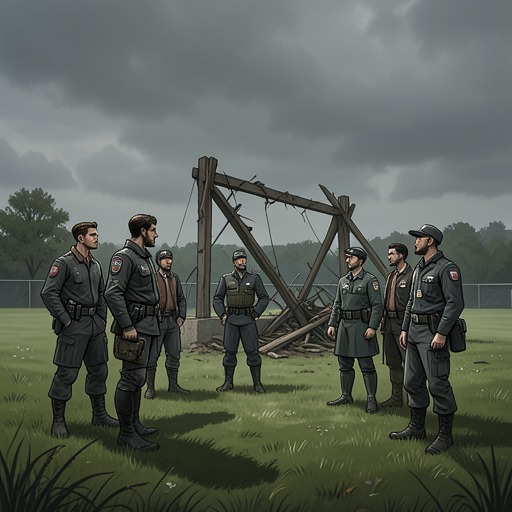
The celebration is interrupted almost immediately. A mocking bark answers the battle cry, but it is not Sox; it is Mickey the Bulldozer. The Wild Soccer Bunch realizes that Mickey and the Unbeatables have surrounded them, including Humungous Henry, Mow-down, Juggernaut Jim, Octopus, Rick the Grim Reaper, and Kong. The passing challenge thus ends not in safety but in confrontation. Its value is tested before the players have time to absorb it, as the new team identity must face the physical intimidation represented by Mickey and his group.
From Training Exercise to Match Strategy
The passing lesson becomes visible during the later match against the Unbeatables. After their battle cry, the Wild Soccer Bunch launches a coordinated attack: Kevin passes to Alex Alexander, Alex returns the ball to Tyler, Tyler sends it toward Danny, and Danny passes onward to Joey. The sequence shows the precise reversal of Kevin’s original instinct. Instead of holding the ball and forcing a solo play, he participates in a chain that moves through several teammates before reaching the goal, even though Octopus ultimately catches the shot.
The same principle governs the comeback. When Kevin reaches the ball in front of Octopus and wants to shoot, he senses pressure behind him and uses a heel pass to Alex Alexander. The move allows Alex to score, with Octopus carried into the goal by the force of the shot. In the rain and mud, the team’s twelve days of difficult field training become an advantage, and coordinated play helps produce the goals that turn a seven-to-one deficit into a seven-to-seven tie and then a nine-to-seven lead. Tyler controls midfield, Danny scores his second goal, Joey equalizes, and Diego forgets his asthma long enough to become the Tornado again.
The challenge’s lesson reaches its sharpest point when Kevin abandons passing once more and keeps the ball because he wants the tenth goal for himself. Larry removes him and sends Roger into the match. Although Kevin protests and later struggles to watch Roger miss a winning opportunity, Larry’s decision forces him to accept that the team’s victory cannot depend on one player’s desire for personal glory. At nine-nine, with the next goal decisive, Kevin finally promises to pass the ball. Roger then scores the winning goal, and the team carries him across the field on its shoulders. The victory confirms the exercise’s central proposition: the player who once seemed least likely to become a hero can decide the match when the group makes room for him.
Narrative Significance
The Sox Passing Challenge is a training event, but its real subject is the conversion of fear, pride, and isolated talent into mutual trust. Sox’s speed exposes the players without malice; Larry’s coaching supplies the structure they lack; and the seventeen-pass finish gives them an experience of success that belongs to everyone. The number ten begins as an external condition, while seventeen becomes the more meaningful measure of how far the team has moved beyond the minimum requirement.
The event also contrasts two models of football identity. Mickey the Bulldozer embodies domination through size, intimidation, and a surrounding group of followers. The Wild Soccer Bunch initially admires individual daring, especially Kevin’s dribbling, but Larry redirects that energy toward passing, precision, and shared responsibility. Even the later victory is not presented as a simple triumph of strength: it depends on Roger’s persistence, Kyle’s saves, Kevin’s eventual willingness to pass, and the battle cry born from the dog exercise. The challenge’s lasting consequence is that cooperation becomes not a concession made by talented players, but the source of their wildness and their power.